
London marketing automation is the use of software to automatically manage marketing tasks, like sending emails, scoring leads, and triggering follow-ups, so your business can convert more customers without adding more staff.
Here is a quick breakdown of what it covers and why it matters right now:
| What it does | Why it matters for London businesses |
|---|---|
| Captures and scores leads automatically | No more leads falling through the cracks |
| Sends personalised emails, SMS, and WhatsApp at the right time | Faster follow-up without manual work |
| Syncs with your CRM to track every contact | Full visibility from first click to closed deal |
| Connects paid ads, website, and sales pipeline | One joined-up system instead of disconnected tools |
| Tracks ROI and campaign performance | Know exactly what is working and what is not |
Right now, there are over 546 marketing automation roles listed in London alone, more than any other UK city. That is a signal. Businesses here are investing heavily in automation because the competition for attention and revenue is fierce.
But here is the problem most small business owners face: they have a website, maybe a CRM, and a few tools, but none of it talks to each other. Leads come in and go cold. Follow-ups are manual and inconsistent. Customer data sits unused. Revenue leaks out at every stage of the journey.
That is exactly the gap marketing automation is designed to close.
I am Kahin Warsame, founder of KWA Digital, a web design and business systems agency that helps businesses build websites, CRM workflows, and automation systems that actually generate and close leads. My work sits at the intersection of London marketing automation and practical operations: connecting the tools businesses already have into systems that work without constant manual effort.
In this guide, I will walk you through the platforms worth evaluating, the costs and ROI to expect, and how to build a setup that fits your business, whether you are running a B2B operation, an ecommerce store, or a service-based company.
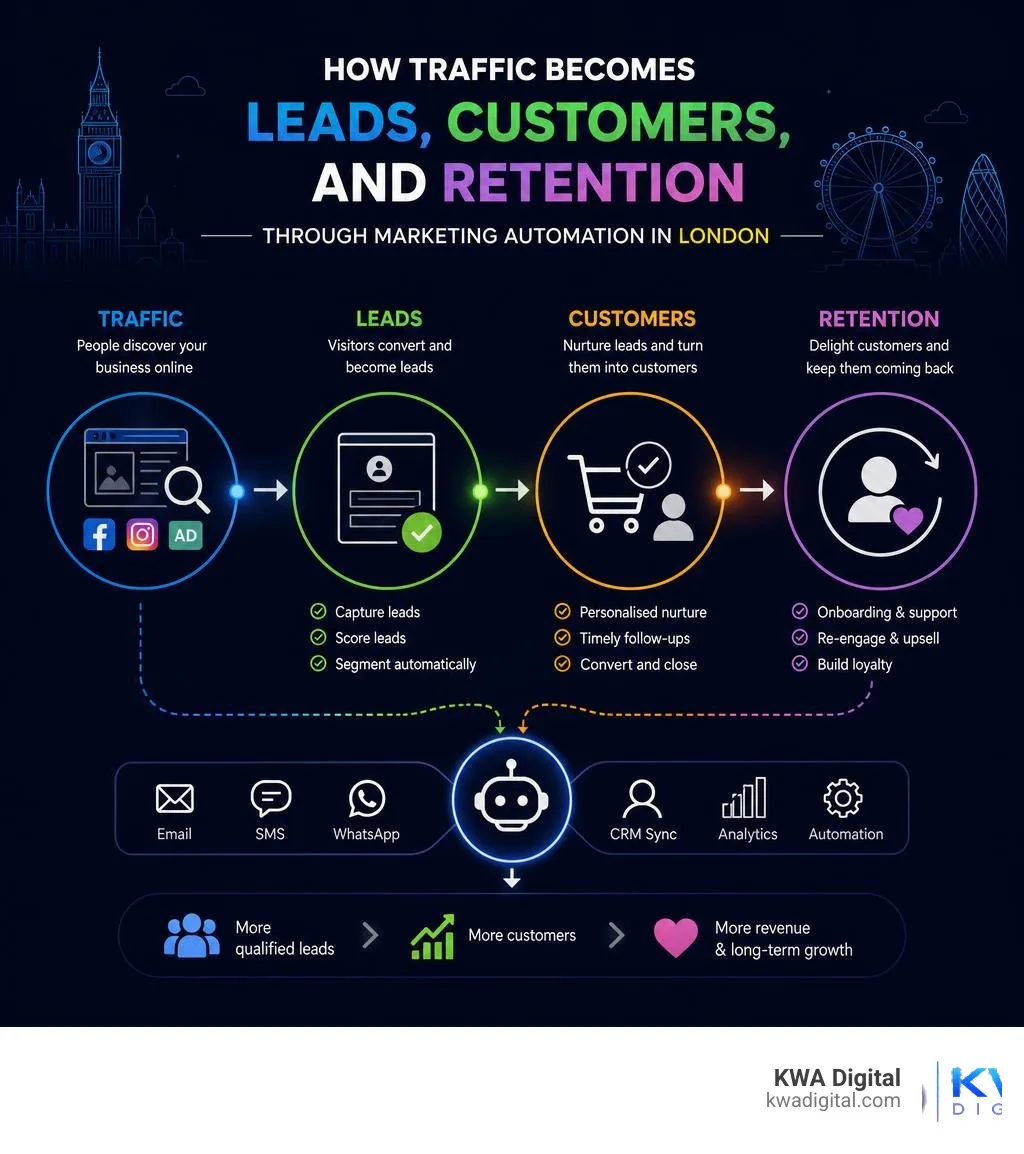
What London marketing automation means in 2026
In July 2026, London marketing automation is no longer just about sending scheduled email newsletters. It is the operational backbone of how a business interacts with its market. For London-based businesses, automation means setting up a system that tracks visitor behaviour across your website, captures intent, and triggers highly relevant communications across multiple channels, including email, SMS, and WhatsApp, without human intervention.
Rather than running isolated campaigns, modern marketing operations focus on building complete customer journeys. This means if a prospect from Canary Wharf downloads a technical whitepaper, they do not just get a generic "thank you" email. Instead, their interaction triggers a multi-stage workflow: their lead score increases, their profile in your CRM is updated, and they receive tailored follow-up messages based on the specific industry topics they read.
How marketing automation connects CRM, websites, and campaigns
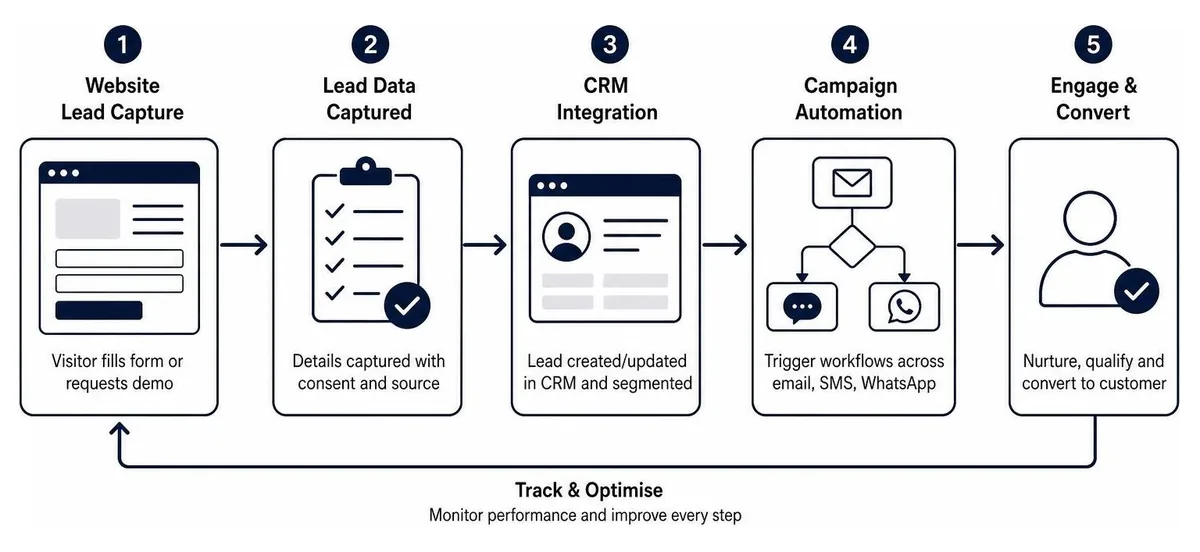
An effective automation system acts as the connective tissue between your public-facing website and your internal sales database. When a visitor fills out a contact form or requests a demo, the automation platform instantly captures their details, logs their explicit consent for GDPR compliance, and matches them against your target audience segments.
This ensures a seamless flow of data. Instead of sales teams manually copying lead details from website inbox alerts, the system automatically routes the qualified lead to the right account manager while triggering a personalised nurture sequence.
Marketing automation vs CRM: the practical difference
While they are highly complementary, marketing automation and Customer Relationship Management (CRM) systems serve fundamentally different purposes.
- Marketing automation is the engine that generates, nurtures, and qualifies leads at scale. It focuses on the top and middle of your marketing funnel, tracking online behaviour, managing automated email sequences, and scoring leads based on engagement.
- CRM (Customer Relationship Management) is the database of record for your sales and account management teams. It tracks direct human-to-human interactions, manages the commercial sales pipeline, and holds the historical record of closed deals and customer communications.
| Responsibility | Marketing automation | CRM operations |
|---|---|---|
| Primary audience | Unqualified prospects, cold leads, and active subscribers | Active deals, qualified leads, and existing customers |
| Core activity | Automated lead nurturing, email campaigns, and behavioural tracking | Sales pipeline management, manual notes, and deal tracking |
| Key metrics | Click-through rates, lead scores, and campaign engagement | Pipeline value, win rates, and customer lifetime value |
| Data managed | Web visits, email opens, and content downloads | Contract values, sales activities, and billing history |
Why London B2B and B2C teams automate differently
London's B2B and B2C landscapes demand completely different automation strategies due to the nature of their sales cycles.
For B2B companies, such as fintech firms in the Square Mile or SaaS providers in Shoreditch, sales cycles are long, complex, and involve multiple decision-makers. B2B automation focuses on Account-Based Marketing (ABM), lead scoring, and long-term email nurture sequences that educate prospects over several months.
For B2C companies, like West End retailers or e-commerce brands, the focus shifts to speed and high-volume engagement. B2C automation relies on short conversion paths, instant WhatsApp updates, abandoned cart recovery sequences, and automated loyalty rewards to drive repeat purchases and maximise customer lifetime value.
The marketing automation tech stack roundup: what to evaluate before buying
Choosing the right software is one of the most critical decisions you will make. The goal is to build a stack that integrates with your existing tools rather than forcing you to rebuild everything from scratch.
Core automation platforms for London agencies and enterprises
For large-scale operations and multi-brand enterprises, enterprise-grade marketing suites offer the governance and scale required to run complex regional campaigns.
- Salesforce Marketing Cloud (SFMC): The gold standard for enterprise-level automation. It provides incredibly deep journey-building capabilities, advanced audience segmentation, and multi-brand governance. It is highly suited for large organisations managing complex customer profiles across EMEA.
- Marketo Engage: A powerful B2B marketing automation platform that excels in lead scoring, multi-channel nurturing, and deep integration with Salesforce CRM. It is ideal for enterprise B2B marketing teams that require robust lead lifecycle management.
CRM-native and sales-aligned automation systems
If your primary goal is to align your marketing activity directly with your sales pipeline, a CRM-native automation system is often the most efficient route.
- Microsoft Dynamics 365 & ClickDimensions: A highly popular combination for mid-market and enterprise businesses in London. ClickDimensions runs natively inside Dynamics 365, meaning there is zero data synchronisation lag. It allows marketing teams to build automated journeys, track web visits, and run email campaigns directly using their core CRM data.
- HubSpot: Known for its user-friendly interface, HubSpot combines marketing automation, sales pipelines, and customer service tools in a single platform. It is highly effective for growing SMEs that want an all-in-one system without complex custom API development.
Ecommerce, SaaS, and service-business automation tools
Smaller, more agile businesses often require platforms that can be deployed quickly and integrate natively with online stores or subscription management tools.
- Klaviyo: The dominant automation platform for e-commerce brands. It integrates seamlessly with Shopify and WooCommerce, allowing businesses to trigger highly personalised campaigns based on real-time purchase history and browsing behaviour. To understand how to connect these systems to your website, check out our guide on ecommerce integration software.
- ActiveCampaign: A versatile platform that combines email marketing, automation, and a lightweight sales CRM. It is highly popular among SaaS startups and service agencies due to its powerful visual automation builder and affordable entry points.
Analytics, dashboards, and attribution layers
An automation system is only as good as the data it produces. To measure success, London businesses use advanced reporting layers to connect marketing activity directly to revenue.
By integrating your marketing automation platform with tools like Power BI or Looker Studio, you can build unified BI dashboards that track conversion rates, pipeline source attribution, and campaign ROI. This removes the guesswork from your marketing spend, showing you exactly which automated workflow generated the most closed sales.

Building the business case: costs, ROI, and implementation risks
Implementing marketing automation is an investment in your business infrastructure. To secure budget and ensure success, you need a clear understanding of the costs, expected returns, and potential roadblocks.
Expected benefits for London businesses
The numbers behind marketing automation speak for themselves. On average, companies that implement marketing automation report a 14.5% increase in sales productivity and a 12.2% reduction in overall marketing overhead.
Furthermore, B2B companies see a 451% increase in qualified leads compared to those relying on manual outreach. For London-based businesses, working with specialised automation systems typically yields a 200% to 300% return on investment (ROI) within the first 6 to 9 months of implementation.
Typical implementation costs and timelines
The cost of automation varies based on the complexity of your business processes and the platforms you choose:
- SME setup: For smaller businesses using platforms like ActiveCampaign or Klaviyo, setups typically range from £1,000 to £3,000. Simple workflows, such as automated lead responses and basic email sequences, can go live in 2 to 4 weeks.
- Enterprise rollout: For larger organisations implementing Salesforce Marketing Cloud or Microsoft Dynamics 365, projects can range from £10,000 to over £50,000. These implementations involve deep API integrations, custom dashboard builds, and extensive team training, usually taking 3 to 6 months to fully deploy.
If you are budgeting for the website side of the system at the same time, see our full breakdown of what a small business website really costs.
Common challenges that reduce ROI
Many automation projects fail to deliver their expected ROI because of a few common mistakes:
- Dirty data: Importing duplicate, outdated, or unconsented contacts into a new system will ruin your deliverability rates and skew your reporting.
- Disconnected systems: If your website, automation tool, and CRM do not sync in real time, your sales team will miss hot leads, and prospects will receive irrelevant messages.
- Over-automation: Creating overly complex customer journeys with hundreds of triggers often leads to system instability and a confusing customer experience. Start simple and scale up.
How to measure marketing automation ROI
To track the financial impact of your automation system, you should regularly monitor these key metrics:
- Marketing-sourced pipeline: The total value of sales opportunities created directly by automated marketing campaigns.
- Cost per qualified lead (CPQL): How much you spend to acquire a lead that meets your sales team's qualification criteria.
- Customer acquisition cost (CAC) reduction: The decrease in marketing and sales costs required to acquire a single customer.
- Sales cycle length: The average time it takes for a lead to move from initial website inquiry to a closed sale.
Skills, AI, and operating models for high-performing automation teams
To run a successful automation system, you need the right mix of technical expertise, strategic planning, and operational support.
Marketing automation skills London employers want
Based on current London job postings, businesses are looking for marketing automation managers who can bridge the gap between marketing strategy and technical execution. Key skills in high demand include:
- Platform expertise: Hands-on experience managing platforms like Marketo, HubSpot, or Salesforce Marketing Cloud.
- Data governance & GDPR: A deep understanding of UK data protection laws, consent tracking, and database hygiene.
- Technical basics: Proficiency in SQL for audience segmentation, HTML/CSS for email template design, and API basics for connecting third-party tools.
- Analytical skills: The ability to build dashboards in Power BI or Looker Studio and translate data into actionable marketing strategies.
How London marketing automation teams use AI without losing control
AI is transforming how we build marketing systems, but the most successful London teams use it as an assistant rather than a replacement for human strategy.
Modern teams leverage AI for predictive lead scoring, automated A/B testing, and send-time optimisation to ensure emails land in inboxes when users are most active. However, strict model governance and human approval steps remain essential to ensure brand voice consistency and prevent automated messaging errors.

Agency vs in-house: choosing the right operating model
When building your automation team, you have three primary paths: hire an in-house specialist, partner with an agency, or bring in an interim consultant to fix existing systems.
For complex, enterprise-level platforms, senior marketing operations specialists provide the deep architecture skills needed for large-scale customer journeys across tools like Salesforce Marketing Cloud and Dynamics 365.
If your current setup is messy or underperforming, an interim consultant or a systems-focused agency can step in to audit your data flows, align your CRM, and build stable, documented workflows that your internal team can manage long-term.
Industry playbooks for London marketing automation
Every industry has unique customer journeys, regulatory requirements, and integration needs. Here is how different sectors tailor their automation setups.
Financial services and regulated industries
For fintech firms and financial services in the City of London, compliance is the absolute priority. Automation systems in this sector require strict permission controls, detailed audit trails, and secure data handling to comply with UK GDPR and FCA regulations.
Automation is used to manage preference centres, qualify high-net-worth leads, and ensure a seamless handoff to financial advisers once a prospect meets strict compliance and lead-scoring criteria.
Ecommerce and retail
London's retail brands use automation to create highly personalised shopping experiences. Key workflows include:
- Abandoned basket recovery: Triggering a multi-stage email and SMS sequence within 30 minutes of a user leaving items in their cart.
- Post-purchase loyalty: Automatically sending product care guides followed by personalised product recommendations based on purchase history.
- Replenishment campaigns: Triggering reminders to reorder consumable products right before they are expected to run out.
SaaS and B2B technology
For SaaS companies, automation is the key to driving product adoption and reducing churn. Workflows focus on the user lifecycle:
- Trial activation: Sending automated tips and feature guides based on what the user has (or has not) done inside the app during their trial period.
- Product-qualified leads (PQLs): Alerting the sales team automatically when a trial user reaches a specific usage threshold that indicates they are ready for an enterprise upgrade.
Events, education, and membership organisations
Managing registrations, attendance, and student journeys requires highly coordinated communications. In the education and events sector, integrating a CRM like Microsoft Dynamics 365 with event technologies streamlines registration workflows and customer journey tracking from initial enquiry to final enrolment.
These systems automate event reminder sequences, post-event feedback collection, and targeted content delivery based on attendee interests, ensuring high engagement across both digital and physical touchpoints.
Trends shaping London automation strategy in 2025-2026
The automation landscape is evolving rapidly. To stay competitive, London businesses must adapt to changes in data privacy, channel preferences, and integration technology.
GDPR, consent, and data governance are now growth requirements
Data privacy is no longer a legal checkbox. It is a competitive advantage. With the tightening of UK GDPR standards, businesses must build privacy by design into their automation systems. This means setting up clear double-opt-in workflows, maintaining accurate consent records across all platforms, and making it easy for users to manage their preferences. Businesses that respect user data build deeper trust and achieve significantly higher email deliverability rates.
Omnichannel journeys are replacing single-channel drip campaigns
Relying solely on email is no longer enough. Modern automation systems orchestrate journeys across multiple channels, including SMS, WhatsApp Business API, paid retargeting ads, and on-site personalisation. For example, if a high-value lead does not open an important email, the system can automatically trigger a WhatsApp update or show them a targeted LinkedIn ad, ensuring your message gets through on their preferred channel.
Integration quality is becoming the main competitive advantage
The success of your automation depends entirely on how well your tools communicate. Custom API connections and robust CRM synchronisation are now essential to create a single customer view. When your website, booking system, payment gateway, and CRM are fully connected, your automation runs reliably, and your reporting remains accurate. To explore how connected digital systems drive business growth, read more on our blog.
Frequently asked questions about London marketing automation
What is the best marketing automation setup for a London business?
The best setup depends on your business model, budget, and existing software. For B2B companies looking for deep CRM alignment, a combination like HubSpot or Microsoft Dynamics 365 with ClickDimensions is highly effective. For e-commerce brands, Klaviyo integrated with Shopify is the industry standard. The key is to choose a platform that fits your team's technical skills and integrates natively with your core systems.
How much does marketing automation cost in London?
For small to medium businesses, software licences and basic setup projects typically range from £1,000 to £3,000, with ongoing monthly management costs from £999. Enterprise-level implementations involving platforms like Salesforce Marketing Cloud or custom CRM integrations can range from £10,000 to over £50,000 depending on complexity and data migration needs.
When should a business hire an agency instead of an in-house specialist?
You should consider partnering with an agency or hiring an external consultant if you need to deploy a complex system quickly, have messy data that needs cleaning, or require specialist technical skills (like custom API integrations or advanced dashboard building) that your internal team lacks. An agency can build and document your system, then train your in-house team to run it day-to-day.
Conclusion
Building a high-performing marketing system is not about buying the most expensive software on the market. It is about connecting your website, your CRM, and your communication channels into a single, cohesive system that works automatically to turn traffic into revenue.
At KWA Digital, we design and build websites, operational dashboards, and custom automations that integrate your marketing and business operations. We focus on building demo-first, fully connected systems that remove manual bottlenecks and help your business scale efficiently.
If you are ready to stop losing leads and build an automation system tailored to your business, explore our services or get in touch to book a consultation. Let's build a system that drives predictable growth for your business.
Stop losing leads to disconnected tools.
Tell us how your business works today, and we will show you a working demo of the automation system we would build around it. Clear scope, honest pricing, no surprises.
Request a free demo