
Understanding the small business website price before you commit to anything is one of the smartest moves you can make as an owner. Costs vary widely, from a few hundred dollars a year to tens of thousands, depending on how you build it and what you need it to do.
Here is a quick snapshot so you can orient your budget right away:
| Website type | Build cost | Ongoing cost (monthly) |
|---|---|---|
| DIY website builder | $0 - $500 setup | $15 - $50/month |
| Simple professional site (5-10 pages) | $2,000 - $5,000 | $50 - $200/month |
| Mid-size business site (10-50 pages) | $5,000 - $20,000 | $50 - $1,000/month |
| E-commerce site | $5,500 - $100,000+ | $50 - $5,000/month |
For most small businesses, the realistic range is $500 to $5,000 for the initial build, plus $50 to $200 per month in ongoing costs for hosting, maintenance, and security.
But that top-line number only tells part of the story. The real cost depends on what is inside the site: the domain, hosting, SSL certificate, design, content, and features you choose. Miss one of these and you will face surprise invoices down the road.
This guide breaks every component down clearly, so you can budget with confidence and avoid the most common money traps.
I am Kahin Warsame, founder of KWA Digital, a web design and business systems studio that has helped small businesses build conversion-focused websites and automated workflows that actually generate leads. I have seen how unclear small business website pricing causes owners to either overspend on things they do not need or underspend in ways that cost them customers. By the end of this guide, you will know exactly what you are paying for and why.
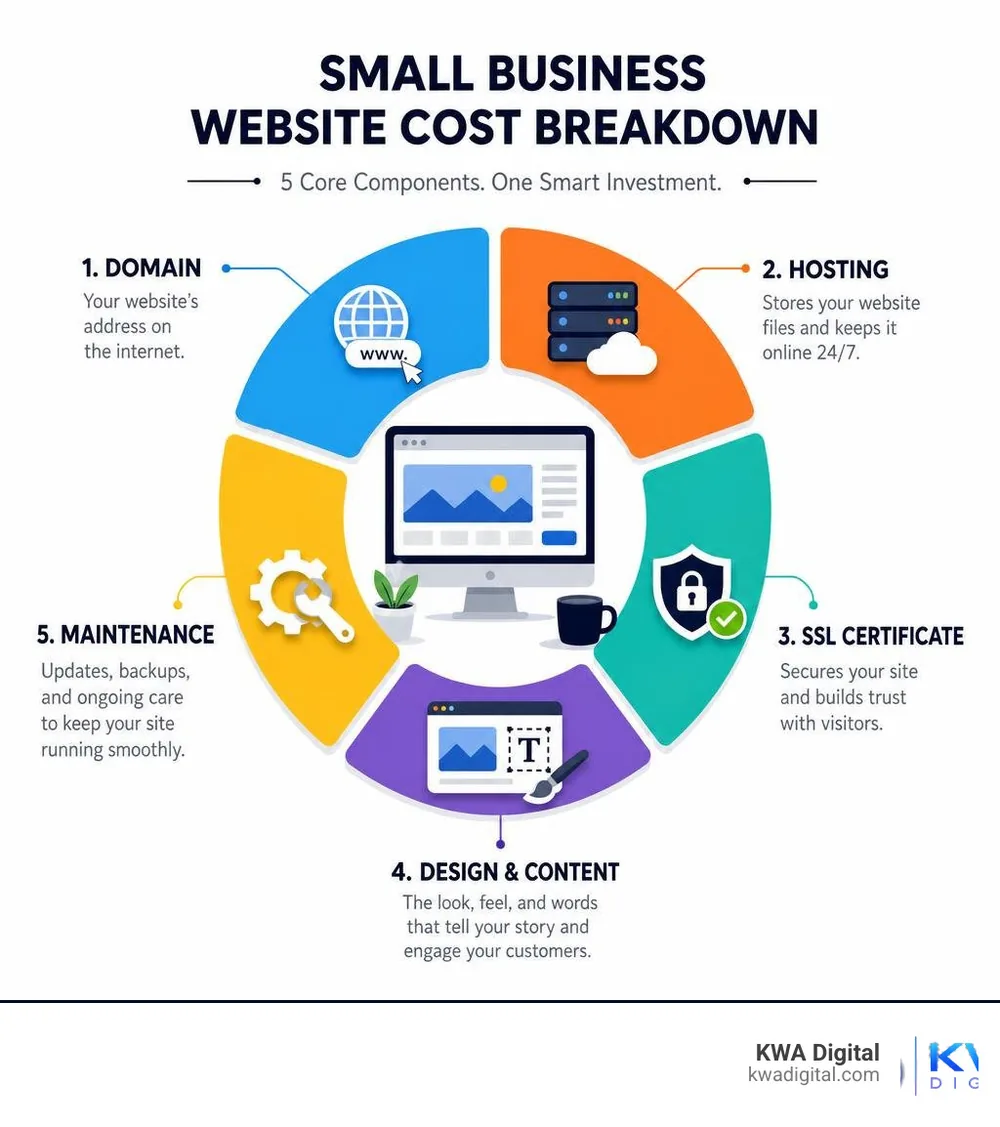
Core components of a small business website price
When you buy a house, you are not just paying for the bricks. You are paying for the land, the plumbing, the interior design, and the ongoing property taxes. A website works the exact same way. To understand where your money goes, we need to strip the website down to its fundamental digital components.

1. Domain name (your digital address)
Your domain name is your address on the internet (like yourbusiness.com).
- Typical cost: $10 to $20 per year.
- The catch: Premium domain names (highly sought-after names that someone else already owns) can cost hundreds or even thousands of dollars. Additionally, you should budget about $10 to $15 annually for domain privacy protection, which keeps your personal contact details out of public spam databases.
2. Web hosting (your digital land)
If your domain is your address, hosting is the actual plot of land where your website's files live.
- Shared hosting ($2.50 - $10/month): Your site shares server resources with hundreds of other websites. It is cheap but can lead to slow loading speeds if another site on your server gets a sudden spike in traffic.
- VPS (Virtual Private Server) hosting ($20 - $100/month): A middle-ground option where you get dedicated resources on a shared server, offering better speed and stability.
- Managed WordPress/cloud hosting ($30 - $75/month): Highly optimized hosting specifically built for WordPress or cloud-based applications. This includes automatic backups, security scans, and faster load times.
- Dedicated hosting ($80 - $300+/month): You rent an entire physical server. This is only necessary for massive enterprise sites or heavy e-commerce applications.
3. SSL certificate (your digital security guard)
An SSL (Secure Sockets Layer) certificate encrypts the data passing between your website and your visitors. It turns your URL prefix from http:// to https:// and displays the padlock icon in web browsers.
- Typical cost: $0 to $100 per year (many modern hosts provide a basic Let's Encrypt SSL for free, while premium wildcard or business-validated SSLs can cost up to $300 per year).
- Is it necessary? Absolutely. Modern search engines like Google actively penalize sites without SSL certificates, and web browsers will display a scary "Not Secure" warning to your visitors, killing your credibility instantly.
4. Website design and development (the structure and style)
This is the physical construction of your site. It includes the user interface (UI) design, coding, mobile responsiveness, and setting up your navigation.
- Typical cost: $0 (pure DIY templates) to $10,000+ (custom agency builds).
- The reality: The complexity of your design and how many custom page layouts you require are the biggest drivers of the upfront small business website price.
5. Content creation and professional images (the furniture)
A beautiful house is empty without furniture. Your website needs copy (words), photos, and graphics to convert visitors into paying clients.
- Copywriting: Expect to pay $50 to $150 per page for professional web copywriters who understand SEO and conversion psychology.
- Visuals: Professional photography or custom graphics can run from $500 to $2,000. While free stock photos are an option, they often make a business look generic and cold. In 2026, we strongly advise against overusing generic AI-generated imagery, as customers have developed a keen eye for fake, plastic-looking visuals and will quickly lose trust in your brand.
Core website cost components comparison
| Component | Upfront cost | Ongoing annual cost | Necessity level |
|---|---|---|---|
| Domain name | $0 (often bundled) | $10 - $20 | Mandatory |
| Web hosting | $0 | $30 - $1,200+ | Mandatory |
| SSL certificate | $0 | $0 - $100 | Mandatory |
| Design & dev | $0 - $10,000+ | $0 (unless outsourced) | Mandatory |
| Content & copy | $0 - $3,000 | $0 (unless updated) | Highly recommended |
| Privacy protection | $0 | $10 - $15 | Recommended |
Website builder vs. professional designer
One of the first decisions you will face is whether to take the DIY route using a modern website builder or to hire a professional designer. Both paths have distinct financial profiles, timelines, and long-term consequences for your business growth.

The DIY route: SaaS website builders
SaaS (Software as a Service) platforms like Wix, Squarespace, and Shopify allow you to rent a website template and customize it using drag-and-drop interfaces.
- The pros: Extremely low barrier to entry. You can get a basic site live over a weekend for as little as $15 to $50 per month.
- The cons: You do not own the underlying code. If you want to move your site to a different platform later because your business has outgrown the builder, you cannot simply export your site; you will have to rebuild it from scratch. Additionally, adding advanced features or custom integrations often requires expensive monthly add-ons that quickly drive up your operating costs.
The hybrid route: open-source visual builders
Using WordPress combined with visual builders like Elementor offers a powerful middle ground. You own your site entirely, and you can use visual drag-and-drop tools to design it.
- The pros: Complete control, massive scalability, and access to thousands of free or cheap plugins.
- The cons: A steeper learning curve than pure SaaS builders. You are responsible for managing your own hosting, security, and software updates, which can be daunting if you lack technical confidence.
The professional route: freelancers and agencies
Hiring an expert means you are paying for their strategic expertise, design skills, and technical knowledge.
- Freelancers: Often cost between $2,000 and $8,000 for a custom small business site. Great for standard business sites, but quality and communication can vary widely.
- Agencies: Typically charge $10,000 to $35,000+ for custom, high-performance sites. They bring a full team of designers, developers, copywriters, and SEO specialists to the table.
- Alternative managed services: Some providers offer subscription-based web design models, allowing you to get a professionally built website with a low setup fee and a modest monthly subscription, avoiding a massive upfront cost.
Average small business website price: DIY vs. professional
To make the right choice, you must compare the true cost of ownership over a multi-year period. A cheap upfront option can sometimes cost you more in the long run.
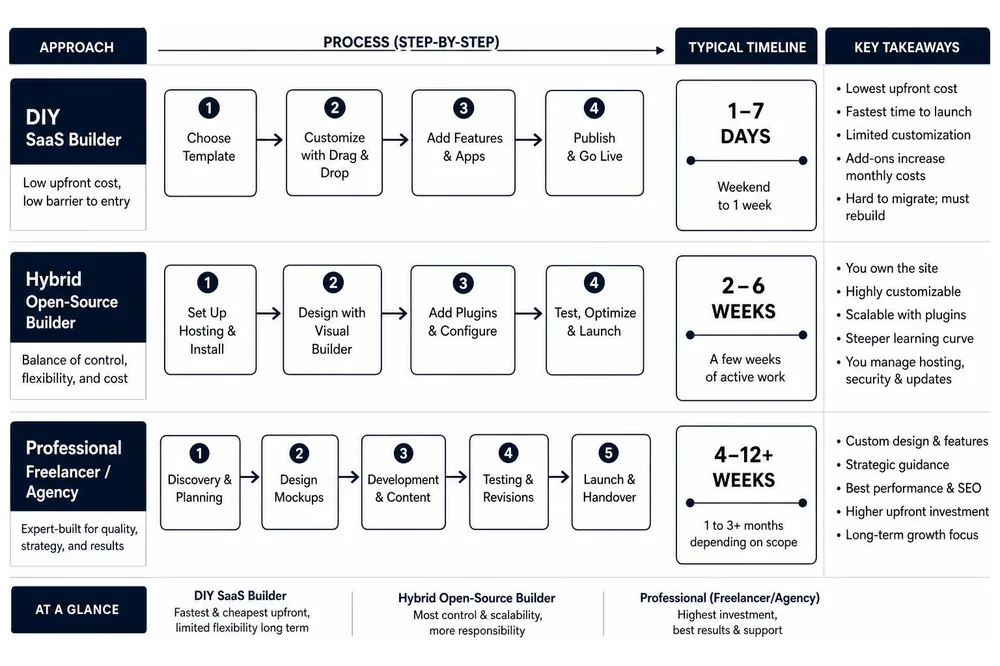
Let's look at the estimated three-year Total Cost of Ownership (TCO) across different approaches:
- DIY SaaS builder route: Upfront cost of $0 (your own time and sweat equity), a $30/month platform subscription, and about $10/month in minor plugins or apps. Three-year TCO: about $1,440, plus 40 to 80 hours of your personal labor.
- Freelance professional route: Upfront design and build around $3,500, managed hosting and basic tools at $25/month, and minor annual maintenance around $200/year. Three-year TCO: about $5,000.
- High-end custom agency route: Upfront custom build and strategy around $15,000, premium managed hosting and support at $150/month, and an ongoing SEO/marketing retainer of $1,000/month. Three-year TCO: about $56,400.
While the DIY route is financially appealing, you must ask yourself: Is your time better spent building a website or running your business? If your website fails to convert visitors into clients because of a clunky DIY layout, the lost revenue can easily exceed the cost of hiring a professional. We often showcase custom, high-converting layouts in our portfolio to demonstrate how professional design directly impacts business credibility and lead generation, and our website design and redesign service covers exactly what a professional build includes.
How features affect your small business website price
The scope and functionality of your site are the main dials that turn the price up or down. A simple "brochure" website that acts as a digital business card is far cheaper than a site that needs to handle online bookings, customer portals, or product sales.
- Page count: A 5-page site (Home, About, Services, Blog, Contact) takes less time to design, write, and build than a 50-page corporate site. Extra pages typically add $100 to $300 per page to your design bill.
- Online scheduling and booking: Integrating dynamic calendars that sync with your team's Google or Outlook calendars, process deposits, and send automated reminders can add $500 to $1,500 in custom setup fees or $15 to $50/month in software subscriptions.
- E-commerce functionality: Setting up product databases, secure shopping carts, tax calculators, and payment gateways is highly complex. Even a small e-commerce store with 10 to 50 products will usually push your professional build cost to at least $5,500.
- Systems integration: If you want your website to talk directly to your internal inventory, CRM, or accounting software, you need specialized middleware. We specialize in configuring ecommerce integration software to bridge these gaps, ensuring your marketing efforts flow seamlessly into your daily operations.
Hidden and ongoing costs of running a website
Many small business owners blow their entire budget on the initial design, only to realize they cannot afford to keep the lights on. To keep your website secure, fast, and visible to search engines, you must budget for ongoing monthly and annual expenses.
- Routine maintenance and security updates ($50 - $200/month): Websites are built on software, and software needs updates. WordPress core files, themes, and plugins require regular updates to patch security vulnerabilities. If you do not want to do this yourself, a professional care plan is a must.
- Accessibility compliance ($200 - $1,500 upfront + ongoing): In 2026, ensuring your website is accessible to users with disabilities is no longer optional. Following recognized standards such as the Web Content Accessibility Guidelines (WCAG) helps improve usability and can reduce legal risk for your business.
- Privacy policy and legal compliance ($100 - $300/year): Privacy laws (like GDPR and CCPA) require websites that collect user data (even just a simple contact form) to have a legally compliant, auto-updating privacy policy.
- SEO and digital marketing retainers ($500 - $2,500+/month): A website is useless if no one can find it. Investing in local SEO, content marketing, and search visibility is crucial if you want your site to act as an active, lead-generating asset.
Frequently asked questions about website costs
Can I build a business website for free?
Technically, yes. Platforms like Wix and WordPress.com offer free plans. However, we strongly advise against this for any serious small business.
Free plans come with severe limitations:
- You cannot use a custom domain (your address will look like
yourbusiness.wixsite.com). - The platform will display their own ads on your website, which looks highly unprofessional.
- You will have extremely limited storage, bandwidth, and zero access to advanced features or SEO tools.
A free website tells potential customers that you are not willing to invest in your own business, which immediately damages your credibility.
How much does it cost to maintain a website annually?
For a standard, informational small business website, you should budget between $145 and $640 per year on the low end to keep the site running. This basic annual operating cost covers your domain renewal ($15/year), shared or basic cloud hosting ($100-$300/year), and essential software licenses or basic SSL certificates ($30-$300/year).
If you hire a professional agency to handle your technical updates, security monitoring, and small content edits, your annual maintenance costs will realistically range from $600 to $2,400+ per year.
What is the price difference between a simple site and an e-commerce site?
The price difference is substantial due to the technical complexity involved in processing transactions.
- Simple website: Primarily informational. It uses basic forms to collect leads and showcases your services. It costs $500 to $5,000 to build and has minimal monthly overhead.
- E-commerce website: Requires a secure shopping cart, payment gateway integrations (like Stripe or PayPal), product inventory databases, automated shipping and tax calculators, and high-level security to protect customer credit card data. A small-to-medium e-commerce build ranges from $2,500 to $15,000+, with ongoing software and transaction fees (typically 2.9% + $0.30 per sale) that increase your monthly operating costs.
Conclusion
At KWA Digital, we do not believe a website should just be a pretty online brochure. Your website should be your hardest-working employee: an always-on sales representative that builds trust, automates your operations, and turns casual visitors into paying customers.
As a founder-led digital studio, we take a demo-first approach. We design custom websites, visual dashboards, and tailored automations built to integrate your marketing front-end with your operational back-end. Instead of forcing you to navigate fragmented systems and surprise development bills, we help you understand your options clearly from day one.
Ready to build a website that drives real business growth? Explore our tailored digital services or learn more about our philosophy and how we help small businesses thrive online. Curious how a custom site gets built? See our walkthrough on building a custom-coded WordPress site. Already have a site and weighing a refresh? See what a website redesign costs.
Know exactly what you are paying for.
Tell us what your business needs, and we will show you a working demo and a clear, honest quote before you commit to anything. No surprise invoices, ever.
Request a free demo