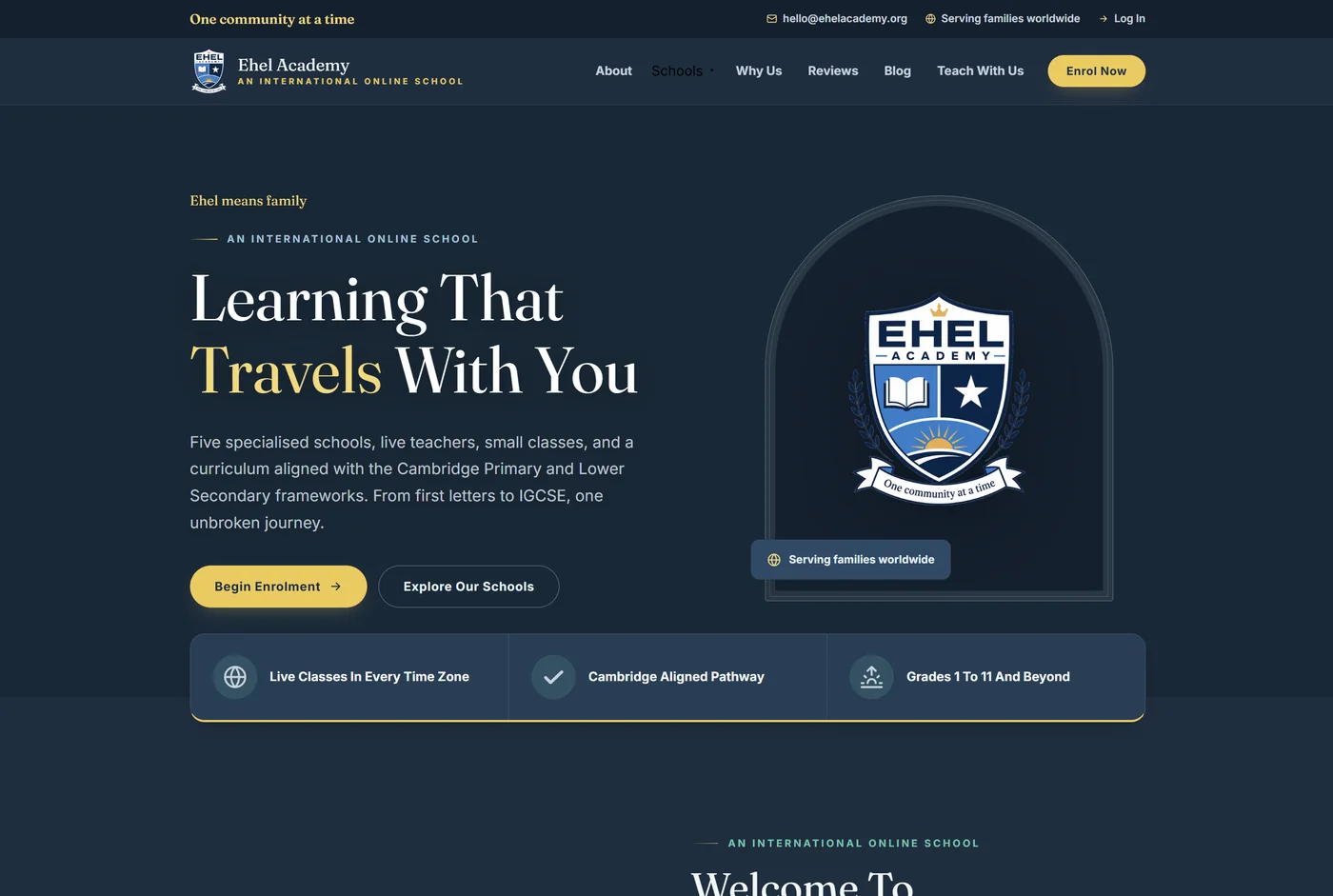
Ehel Academy is an international online school serving families worldwide, with live teachers, small classes, and a curriculum aligned to the Cambridge Primary and Lower Secondary frameworks. KWA Digital built it from the ground up: the website, the original course content, and the learning platform students and teachers use every day. The part most agencies cannot do is the last one. The platform runs on Moodle underneath, but nothing a student sees is Moodle. The entire interface is custom-built.
Ehel means family, and the school is one the KWA team co-founded. That matters for how you read this: it was not a brief handed to us, it was our own school, and we built every layer of it ourselves. It is also why it is the most complete example of what we can do with a learning platform, because we owned every decision from design to backend.
At a glance
| Project | Ehel Academy, an international online school |
|---|---|
| Live site | ehelacademy.org |
| Scope | Website design, original course content, and a custom learning platform |
| Curriculum | Cambridge Primary and Lower Secondary aligned, grades 1 to 11 and IGCSE |
| Platform | Moodle backend with a fully custom frontend in HTML, CSS, JavaScript, and PHP |
| KWA Digital's role | Co-founder, and designer and builder of every layer |
A note on the relationship: KWA Digital co-founded Ehel Academy, so this is our own school rather than a client engagement. We include it here because it shows the full range of the work, from site to content to platform, in one place, with nothing handed off to anyone else.
Three things, built together
An online school needs three things that usually come from three different vendors: a public website that persuades a family to enrol, the actual course material, and a learning platform where the teaching happens. Ehel got all three from one team, which is why they fit together instead of feeling bolted on.
1. The website
The public site at ehelacademy.org does the persuading. It introduces the five specialised schools, the live-class model, and the Cambridge-aligned pathway, and it drives one action: begin enrolment. The design is built around the school's own crest and colours, deep navy and gold, so the site feels like an institution rather than a template. It also carries the practical pieces a family needs, from the schools overview to reviews and a route for teachers who want to join.
2. Original course content
We wrote the course material rather than licensing a generic package. The content follows the Cambridge Primary and Lower Secondary frameworks and is organised into the school's subject tracks, including English, Mathematics, Science, Computing, and Global Perspectives, across their stages. Original content means the courses match how the school actually teaches, live and in small groups, instead of forcing teachers to work around someone else's material.
3. The learning platform, with a custom frontend on Moodle
This is the piece that sets the project apart. Moodle is one of the most widely used learning management systems in the world, and its engine is genuinely good at the hard parts: course structure, enrollment, user roles, grading, and reporting. Its weakness is the interface. Out of the box, Moodle looks like Moodle: generic, dated, and the same as every other school using it.
So we kept the engine and replaced everything on top of it. Moodle runs as the backend only. The frontend, meaning every screen a student, parent, or teacher actually touches, is hand-built in HTML, CSS, JavaScript, and PHP. Learners get a branded workspace on the school's own domain that looks and behaves like Ehel, while the platform underneath stays reliable and standard.
Here is what that custom layer includes.
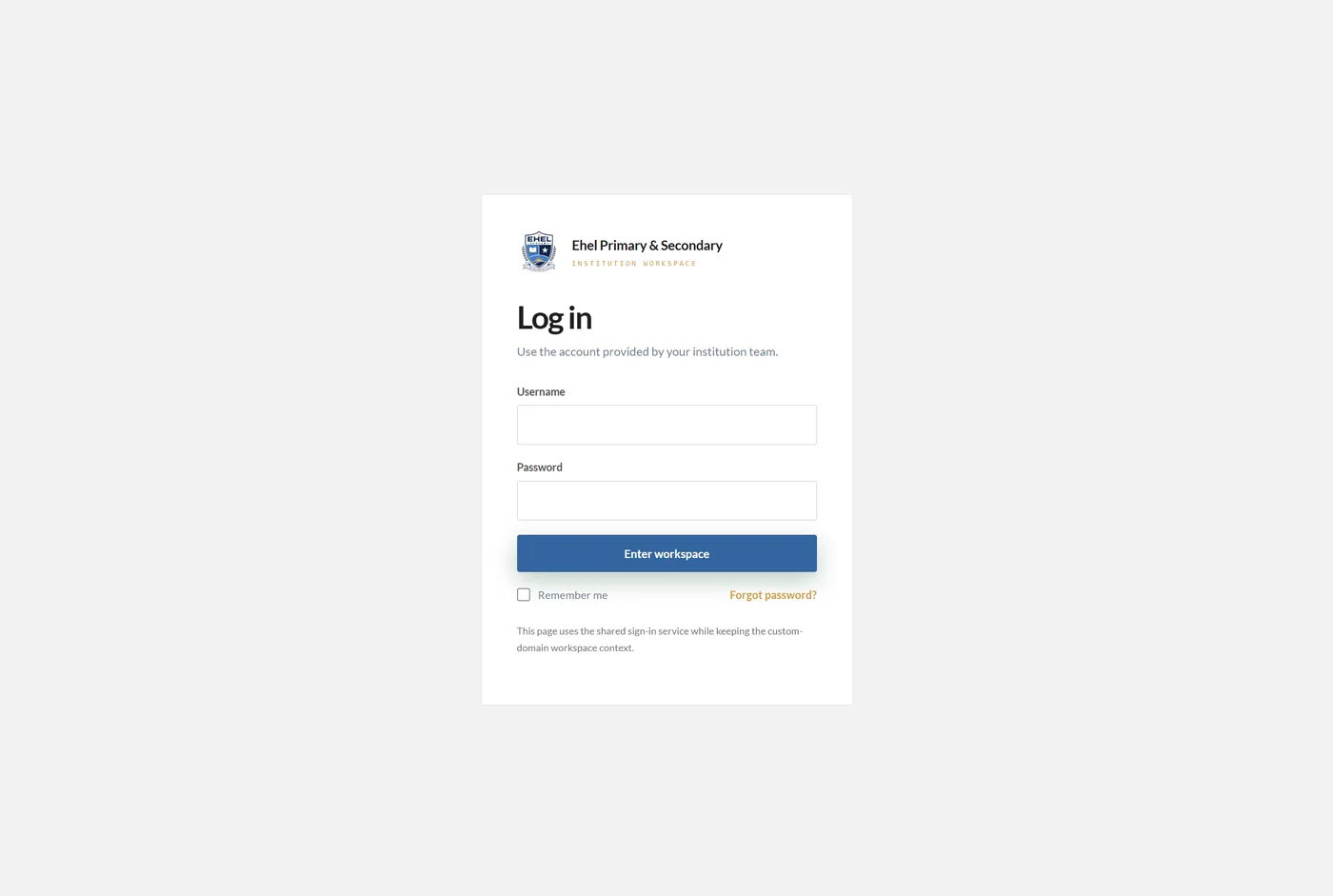
A branded institution workspace. Students and staff sign in to "Ehel Primary and Secondary," not to Moodle. The login runs on the school's custom domain while using a shared sign-in service underneath, so the experience is the school's from the first screen.
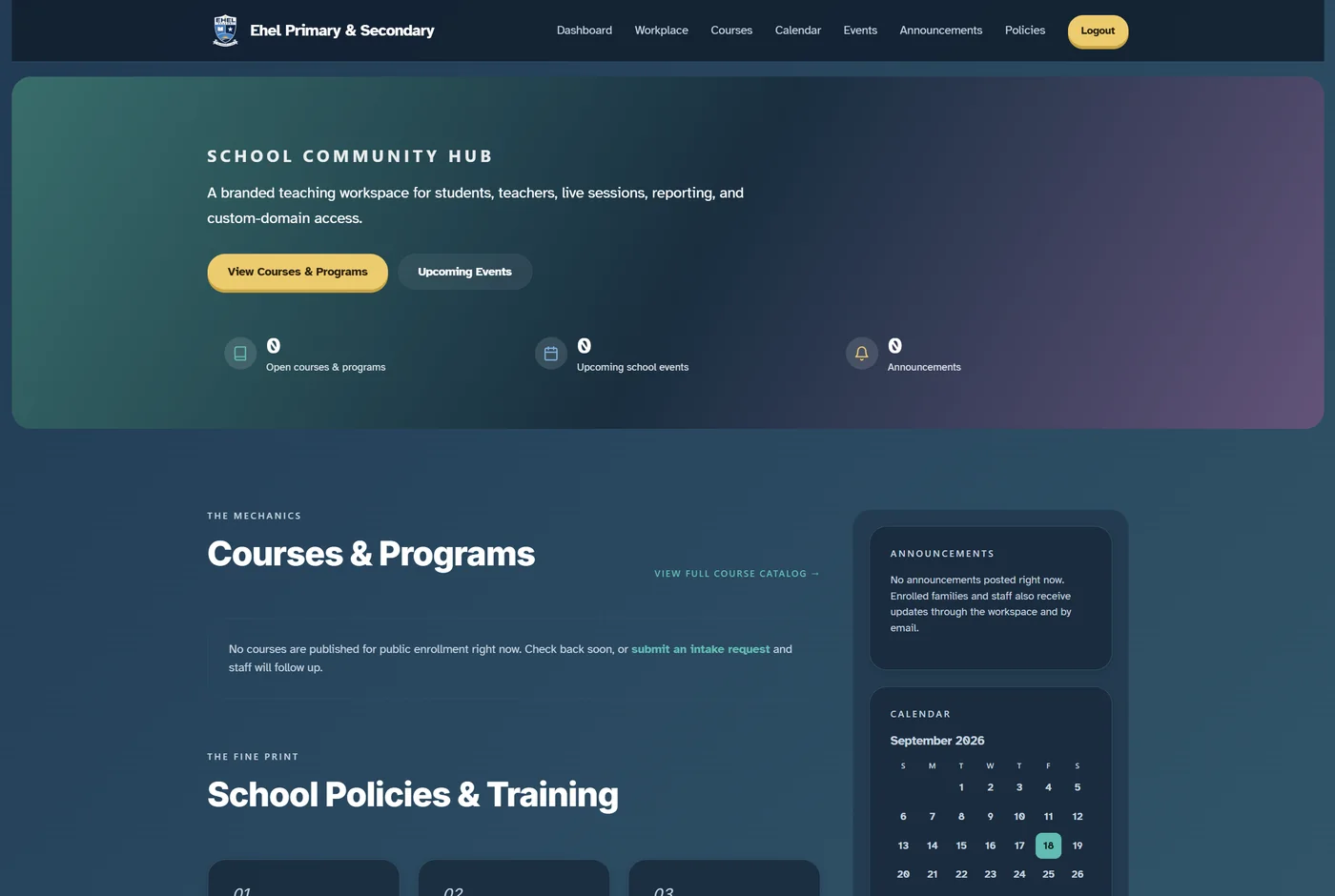
A community hub, not a course list. The dashboard brings the whole school into one place: courses and programs, a calendar, upcoming events, announcements, and the school's policies and training. It is designed as a home for the community rather than the bare list of enrolled courses a default LMS gives you.
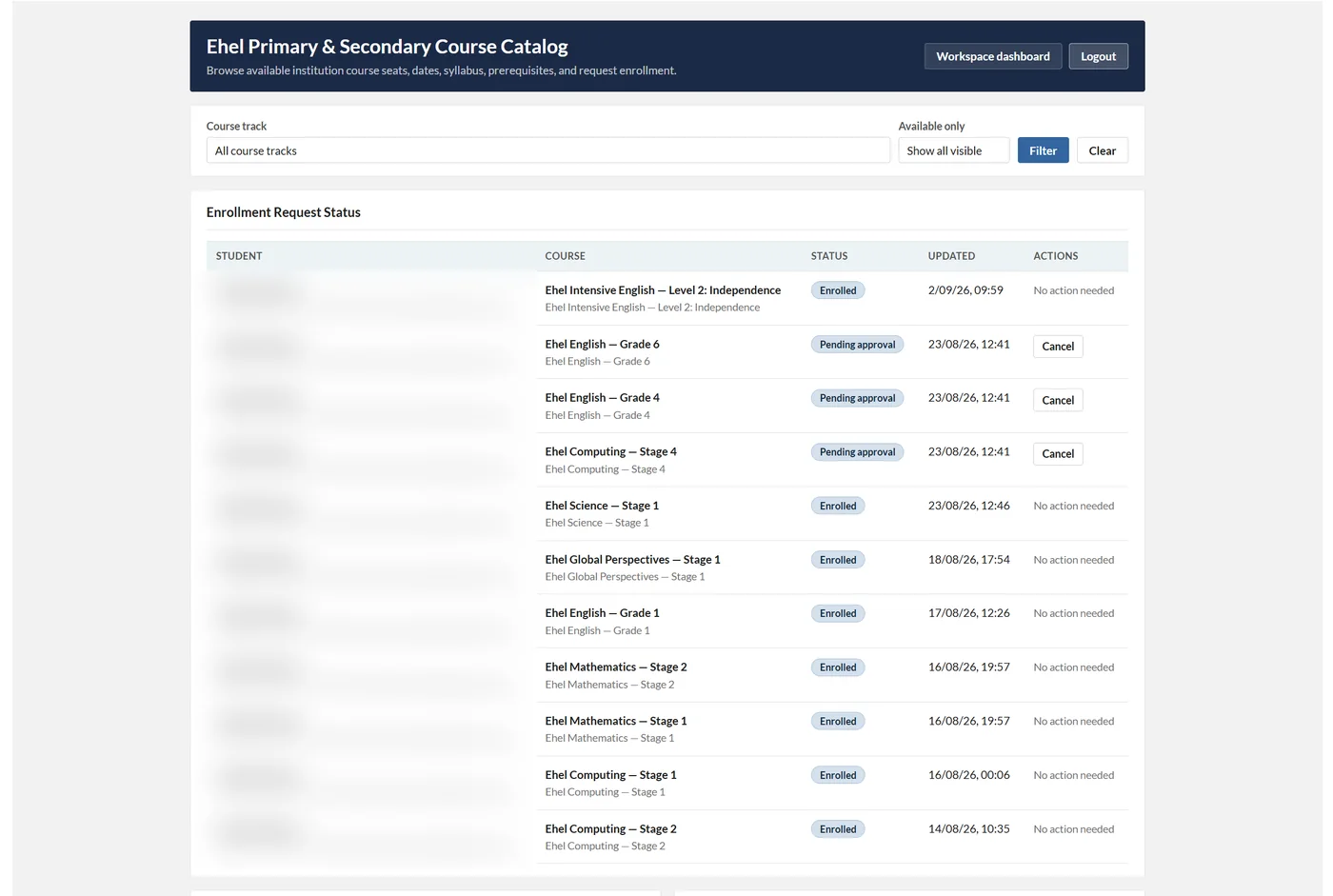
A course catalog with managed enrollment. Families browse course tracks, dates, syllabus, and prerequisites, and request a seat. Each request shows its status, from pending approval to enrolled, and staff approve it inside the same workspace. That gives the school control over who joins which course while keeping the process simple for the family.
Why build it this way
The obvious alternatives were both worse. Building a learning platform from scratch means re-solving problems Moodle solved years ago, and it is slow, expensive, and risky for something as important as grades and enrollment. Using Moodle as-is means every family's first impression is a generic, dated interface that looks nothing like the school. Keeping Moodle's engine and building our own frontend gave Ehel the best of both: a reliable, standard core, and an experience that is entirely its own. We compare the three routes in more depth in why a custom frontend beats building your own LMS.
What this project shows
Ehel Academy is the clearest picture of what we can do with a learning platform, because we built all of it: the site that enrols families, the content teachers deliver, and the platform they deliver it on. Most of all, it shows that a school does not have to choose between a proven LMS engine and a platform that feels like its own brand. You can have both, and this is what it looks like.
It sits alongside our work stabilising and migrating a national learning platform for a chamber of commerce, which you can read in our LMS platform case study. If you are building or replatforming an online school, an academy, or a training programme, see our LMS development service or get in touch and we will talk through what a platform like this would take for you.
Building or replatforming a learning platform?
Tell us about your school or training programme and we will show you how a custom-branded platform on Moodle could work for it, whether that is a fresh build or a custom frontend on the system you already run. Demo-first, clear scope.
See our LMS development service