
The best ecommerce integration software connects your online store to the tools you already use, automatically syncing orders, inventory, customer data, and payments across every system.
Top ecommerce integration platforms at a glance:
| Platform | Best For | Key Strength |
|---|---|---|
| Jitterbit | Mid-to-large retailers | Low-code omnichannel automation |
| Cleo Integration Cloud | B2B and EDI-heavy businesses | End-to-end supply chain visibility |
| Kibo Connect Hub | Enterprise commerce | 3,300+ pre-built integrations |
| Extensiv Integration Manager | Multi-channel fulfillment | 100+ order sources, unlimited volume |
| Pipe17 | Shopify brands scaling fast | AI-native OMS + iPaaS in one |
| Skyvia | SMBs needing quick setup | No-code data sync and automation |
| SixSync | Dropshippers and sellers | Vendor and EDI sync focus |
| APIWORX | High-volume ERP connections | Serverless AWS-powered architecture |
Running an online store without integration is like managing a restaurant where the kitchen, cashier, and waitstaff never talk to each other. Orders get lost. Stock counts go wrong. Customers wait too long.
The numbers back this up. About 70% of businesses spend nearly 40% of their working hours on repetitive manual tasks. Employees lose more than two hours every day just switching between apps. That's time and money draining out of your business daily.
And the stakes are high. The global ecommerce platform software market is on track to grow from $8.09 billion in 2025 to $21.47 billion by 2033. Businesses that connect their systems now will be the ones ready to capture that growth.
I'm Kahin Warsame, founder of KWA Digital. I help businesses eliminate exactly these kinds of operational gaps by building connected systems including CRM workflows, automation pipelines, and the kind of ecommerce integration software setups that turn a fragmented store into a well-oiled revenue machine. In this guide, I'll walk you through the best platforms available and how to choose the right one for your business.
What is Ecommerce Integration and How Does It Work?
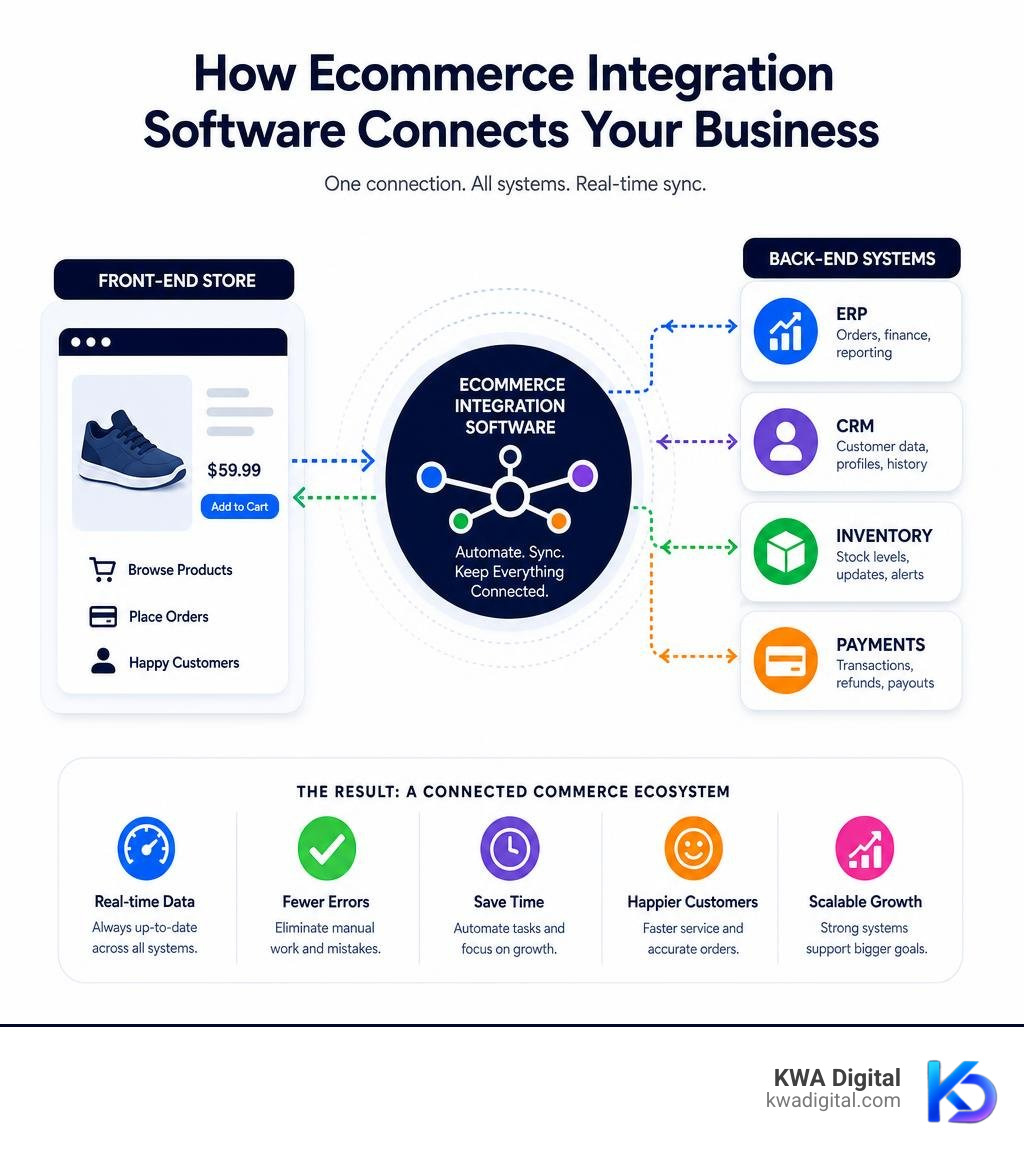
At its core, ecommerce integration is the process of coordinating data flow between your front-end online storefront (such as Shopify or WooCommerce) and your back-office systems (like ERPs, CRMs, inventory managers, and financial ledgers). Instead of keeping your business data locked in isolated silos, integration software serves as a translator and courier, moving information back and forth automatically.
This process relies on bidirectional data flows. Rather than just sending web orders one way to your warehouse, a fully integrated system also pulls inventory updates and tracking numbers back from the warehouse to your storefront.
This seamless flow of data is achieved through three main technical approaches:
- Direct API Endpoints: Applications connect directly via Application Programming Interfaces (APIs). One platform requests data, and the other responds instantly.
- Middleware Platforms: A centralized software layer acts as an intermediary hub. It collects data from one system, translates it into a standardized format, and passes it to the destination system.
- Event-Driven Architecture: Instead of constantly checking for updates (polling), systems respond to real-time events. For example, when a customer places an order, an event is instantly triggered, prompting the ERP and shipping systems to react.
By building these automated bridges, you eliminate the need for manual data entry, reducing human error and keeping all your business systems aligned.
Key Benefits of Integrating Your Store's Ecosystem
When you bridge the gap between your digital storefront and your back-office operations, your entire business runs more smoothly. Key advantages of using ecommerce integration software include:
- Complete Automation: Say goodbye to manually copying and pasting customer addresses, order details, or tracking codes.
- Dramatic Error Reduction: Eliminating manual data entry means no more mistyped shipping addresses, wrong SKU records, or double-booked orders.
- Substantial Time Savings: Free your team from administrative tasks so they can focus on growth, product development, and customer engagement.
- Guaranteed Data Accuracy: When stock levels, prices, and customer profiles sync automatically, your team operates with a single, reliable source of truth.
- Frictionless Scalability: As your transaction volume grows, integrated systems handle the increased load automatically, allowing you to expand without hiring a small army of administrative staff.
How Ecommerce Integration Software Solves the Omnichannel Puzzle
Modern consumers rarely shop in just one place. They might browse your products on Instagram, compare prices on Amazon, buy from your Shopify store, or visit your brick-and-mortar shop.
Managing these touchpoints individually is an operational nightmare. Ecommerce integration software solves this by unifying your sales channels. Platforms like Kibo Connect Hub help centralize your operations, allowing you to manage inventory, orders, and customer profiles across multiple physical and digital locations from a single dashboard.

When your channels communicate effectively, you can easily offer flexible shopping options like Buy Online, Pick Up In Store (BOPIS), ship-from-store, or seamless multi-channel returns.
Enhancing Customer Experience and Support
Your customer experience depends heavily on the speed and accuracy of your back-end operations. If your systems are disconnected, your support team cannot help customers efficiently.
Consider these key factors:
- Accurate Product Information: Nearly 85% of online shoppers decide to purchase based on the product details and images provided. Integration ensures your product descriptions and availability are always accurate.
- Optimized Search Experience: Over 68% of online shoppers are reluctant to return to a site after a poor search experience. Integrating advanced search tools with your real-time catalog prevents customers from finding out-of-stock items.
- Faster Support Resolution: When your customer support platform (like Zendesk or Freshdesk) is connected to your ecommerce and ERP systems, support agents can view order history, tracking details, and payment status instantly, resolving inquiries on the first contact.
- Personalized Retention Marketing: Retaining existing customers is incredibly valuable: nearly 40% of an online business's revenue is driven by just 8% of its repeat customers. By integrating your CRM with your store, you can trigger personalized email campaigns based on purchase history and behavior.
Core Types of Systems Connected by Integration Platforms
To build a fully integrated ecommerce ecosystem, you must connect several key business systems.
ERP and CRM Connections
Your Enterprise Resource Planning (ERP) system serves as your financial and operational ledger, while your Customer Relationship Management (CRM) platform manages your customer relationships. Connecting these to your online store is essential for streamlined operations.
For businesses using open-source frameworks, tools like the ecommerce_integrations release for ERPNext v16 provide reliable ways to link ERPNext with online storefronts, ensuring your financial ledgers and customer profiles stay synchronized.
Integrating these systems ensures that every sale, tax payment, and refund is recorded in your general ledger automatically, while giving your sales team a complete view of customer interactions and purchase history.
Inventory Management and Order Fulfillment
Overselling is one of the fastest ways to lose customer trust. If your website says an item is in stock, but your warehouse is empty, you face cancelled orders and disappointed buyers.
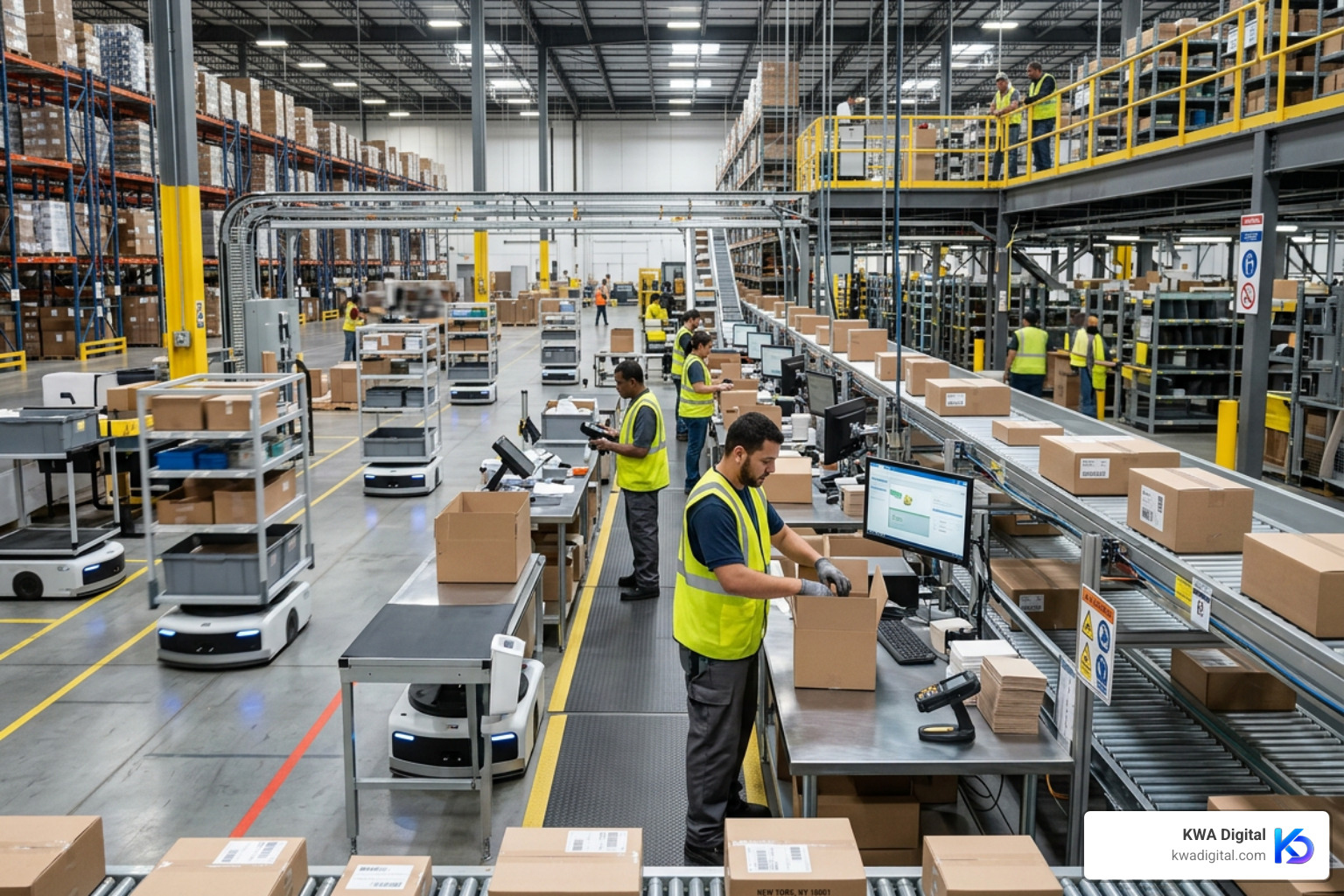
By connecting your storefront with inventory management systems, warehouse management systems (WMS), and third-party logistics (3PL) providers, you can ensure accurate stock levels across all channels. Solutions like Extensiv Integration Manager automate this process by standardizing order details from multiple sources and routing them directly to your fulfillment partners, while updating inventory levels in real time.
Overcoming Common Implementation Challenges
While the benefits of integration are clear, implementing these systems can present several challenges:
- Legacy System Constraints: Older, on-premise software often lacks modern API capabilities, making direct cloud connections difficult.
- Complex Data Mapping: Different systems use varying naming conventions for data fields. Aligning these fields requires careful planning to prevent data corruption.
- High Initial Costs: Building custom integrations can require a significant investment. However, using pre-built connectors can dramatically reduce these costs.
- System Compatibility: Ensuring that your ERP, CRM, and storefront communicate reliably requires a robust middleware layer that can handle diverse data formats.
You can overcome these obstacles by auditing your existing data, clearly defining your integration requirements, and selecting a platform that offers pre-built connectors for your specific software stack.
Security and Compliance Considerations
Connecting multiple systems requires sharing sensitive customer and financial data across platforms. Maintaining high security standards is critical to protecting your business and your customers.
Key security practices include:
- Data Encryption: Ensure all data is encrypted both in transit (using HTTPS/TLS) and at rest.
- Access Control: Implement role-based access controls (RBAC) to ensure employees only access the data necessary for their roles.
- PCI Compliance: If you process payments, ensure your payment gateways are fully PCI-DSS compliant and that sensitive card data is never stored on your servers.
- Regular Security Audits: Conduct routine vulnerability scans and penetration testing to identify and address potential security gaps.
Choosing the Right Ecommerce Integration Software for Your Business
Selecting the right integration platform depends on your business size, technical expertise, and existing software stack.
Key Features to Look for in Ecommerce Integration Software
When evaluating different integration platforms, look for these essential features:
- Pre-Built Connectors: Platforms with out-of-the-box connectors for your specific systems (e.g., Shopify, NetSuite, Salesforce) will dramatically reduce your setup time.
- No-Code Rule Builders: Look for platforms that allow your operations team to manage order routing and data mapping using visual, drag-and-drop interfaces rather than custom code.
- Real-Time Alerts: Choose a system that monitors your data flows and alerts you immediately if a sync fails or an order encounters an error.
- Scalable Infrastructure: Ensure the platform can handle peak traffic periods, such as Black Friday, without slowing down or dropping transactions.
For brands looking for a tailored approach, platforms like SixSync provide flexible options for connecting vendor data, inventory software, and shipping tools, which is particularly useful for dropshipping operations.
Comparing Integration Architectures: iPaaS vs. Unified APIs
Understanding the architectural differences between integration platforms is key to choosing the right system for your business.
| Feature | Point-to-Point | iPaaS | Unified APIs |
|---|---|---|---|
| Architecture | Direct, custom-coded connections between two systems. | Centralized hub translating data between multiple platforms. | Single API endpoint masking multiple underlying systems. |
| Setup Speed | Fast for simple setups, slow for complex ones. | Moderate; requires configuring workflows and mapping. | Very fast; connects to multiple platforms via one endpoint. |
| Maintenance | High; changes in one system can break the connection. | Moderate; managed by the iPaaS provider but requires oversight. | Low; the unified API provider maintains the individual connections. |
| Scalability | Poor; becomes chaotic as you add more systems. | High; designed to handle complex, enterprise-level workflows. | High; easily scales to support new marketplaces or carriers. |
For high-volume merchants, serverless architectures offer a highly resilient option. Platforms like APIWORX leverage cloud-based infrastructure to process millions of transactions smoothly, eliminating the need to manage physical servers.
Similarly, if you are scaling a Shopify-based business, Pipe17 offers an AI-ready, managed order operations platform that combines iPaaS connectivity with robust order management features, allowing you to bypass complex legacy systems entirely.
Frequently Asked Questions
What is the difference between point-to-point and middleware integration?
Point-to-point integration connects two systems directly using custom code. While simple to set up initially, it becomes difficult to maintain as you add more systems, as a change in one application can break the entire connection. Middleware acts as a centralized hub, collecting and translating data from all your systems, which simplifies management and makes it much easier to scale your business.
How long does it take to implement an ecommerce integration?
The implementation timeline depends on the complexity of your systems. Using pre-built connectors on an iPaaS platform can take anywhere from a few days to a month. Custom integrations or legacy ERP setups are more complex and typically require several months of planning, development, and testing to ensure reliable data flows.
Can integration software handle multi-currency and international tax rules?
Yes. Modern integration platforms are designed to support global commerce. They can automatically translate multi-currency transactions into your base accounting currency and route tax data to compliance tools like Avalara or Vertex, ensuring accurate tax calculation and reporting across different regions.
Conclusion
In today's digital landscape, manual data entry and disconnected systems are major obstacles to growth. Implementing the right ecommerce integration software allows you to automate repetitive tasks, eliminate operational errors, and deliver the seamless omnichannel experience your customers expect.
At KWA Digital, we design and build fully connected systems that integrate your marketing, sales, and operations into a single, high-performing revenue engine. Ready to eliminate manual work and scale your online store?
Let's connect your systems.
We build the CRM workflows, automations, and integrations that turn a fragmented store into one revenue engine. Tell us what you are running and we will map it out.
Supercharge your store